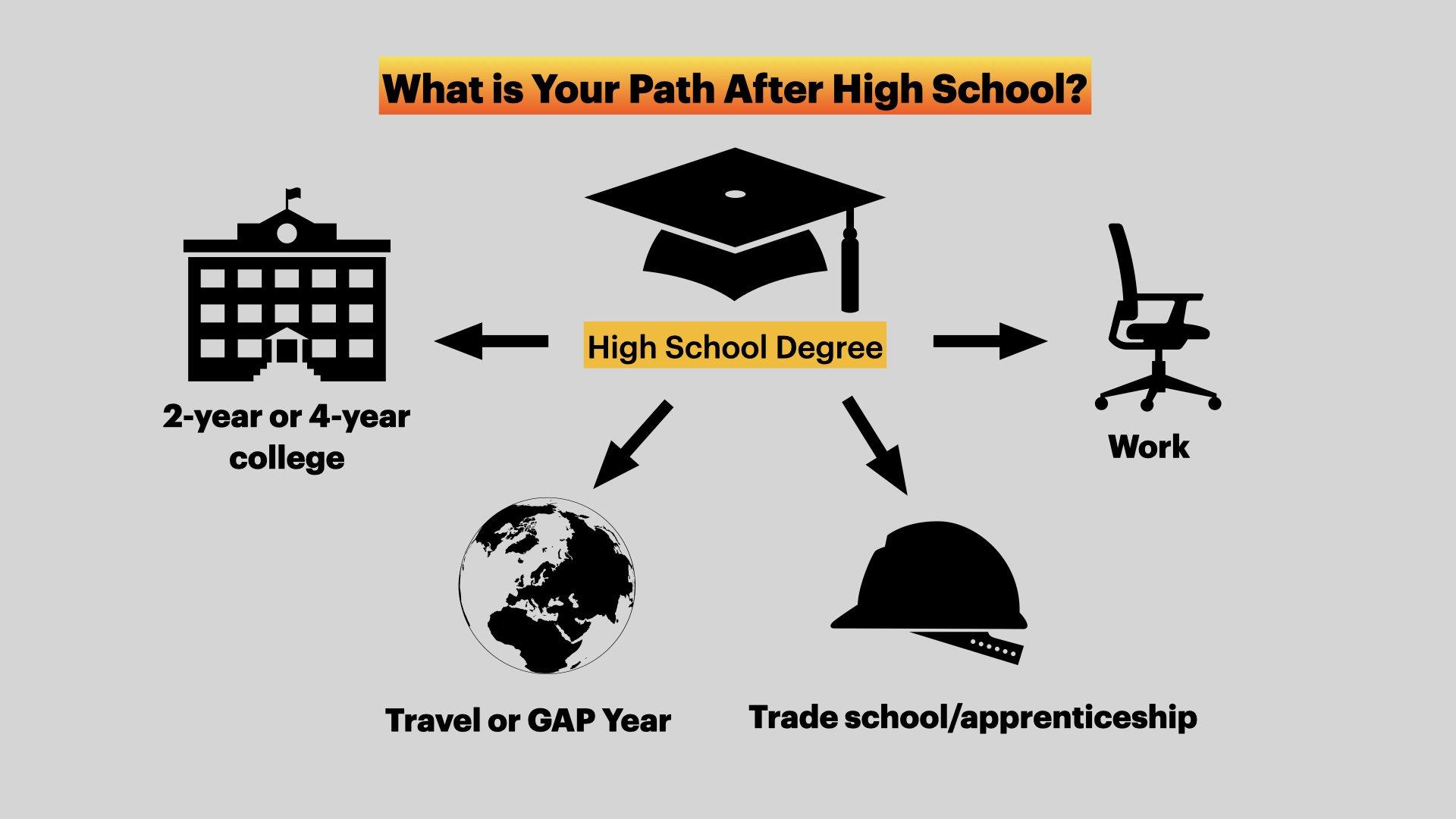
When parents think about life after high school, one path often comes to mind first:
College.
But college is not the only way for a teen to prepare for a successful career. Today’s students have many options after graduation, including four-year colleges, community colleges, career and technical education, apprenticeships, industry certifications, and military service. Some students may even combine several of these pathways along the way.
The important question isn’t simply:
“Is my teen going to college?”
A better question is:
“What pathway makes the most sense for my teen’s interests, strengths, goals, and career plans?”
There is no single path that is right for every student. Understanding the options can help parents have more productive conversations with their teens and encourage them to make thoughtful decisions about their future.
Before deciding what comes after high school, it helps for teens to understand what they enjoy, what they’re good at, and what careers interest them. If your teen is just getting started, [Why Career Exploration Matters in Middle School] is a helpful place to begin.
1. Four-Year College or University
A four-year college or university is one of the most familiar pathways after high school.

Students typically earn a bachelor’s degree while completing courses in a chosen field of study. For some careers, a bachelor’s degree is an important or required step toward entering the profession.
Examples include careers such as:
- Teacher
- Engineer
- Accountant
- Social worker
- Psychologist
- Journalist
- Marketing specialist
- Computer scientist
- Many healthcare professions
A four-year college may be a good option for a teen who enjoys academic learning, wants to pursue a career that requires a bachelor’s degree, or wants the broader college experience.
However, parents should avoid assuming that every student needs to attend a four-year college immediately after high school. The right college—and the right timing—depends on the student’s goals.
👉Questions parents can ask
Instead of simply asking, “What college do you want to attend?”, try:
- What careers are you interested in?
- What type of education does that career require?
- What subjects do you enjoy studying?
- Do you prefer large or small learning environments?
- What are your financial considerations?
- What type of college experience are you looking for?
The goal is to connect the college decision to the student’s future goals, rather than choosing a college simply because it is popular or familiar.
2. Community College
Community colleges are another important pathway that parents should understand.
A community college may offer associate degrees, career-focused programs, certificates, and other forms of workforce training. Many community colleges also provide a pathway for students who want to eventually earn a bachelor’s degree by transferring to a four-year institution.

For some students, community college can provide a more affordable and flexible way to begin postsecondary education.
It can also be a good option for students who:
- Want to stay closer to home
- Want to explore their interests before committing to a four-year college
- Want to earn a career-focused credential
- Prefer smaller classes
- Want to complete general education courses before transferring
- Are interested in technical or healthcare programs
- Want to enter the workforce sooner
Community colleges can also connect education with local workforce needs and offer programs leading to certificates, associate degrees, and—in some cases—bachelor’s degrees.
👉Questions parents can ask
- Does the community college offer programs related to your teen’s interests?
- Can credits transfer to a four-year college?
- What career credentials are available?
- What are the total program costs?
- Are internships or work-based learning opportunities available?
Community college should not be viewed simply as a “backup plan.” For many students, it can be an intentional first step toward a career.
3. Career and Technical Education (CTE)
Career and Technical Education, often called CTE, gives students opportunities to develop academic knowledge alongside technical and career-related skills.

CTE programs can be found in high schools, community colleges, technical schools, and other educational settings.
Depending on the program, students may explore areas such as:
- Health sciences
- Information technology
- Computer science
- Construction
- Manufacturing
- Agriculture
- Business
- Culinary arts
- Transportation
- Public safety
- Education
- Design and media
One of the biggest benefits of CTE is that students can connect classroom learning with real-world applications.
Some programs also allow students to earn industry-recognized credentials, college credit, or hands-on experience. Federal education resources describe CTE and career pathways as ways for students to develop academic and technical skills connected to high-skill, high-wage, and in-demand occupations.
CTE may be especially appealing to teens who:
- Enjoy learning by doing
- Like working with their hands
- Want to see how school connects to real careers
- Enjoy technology or technical problem-solving
- Want to develop a specific skill
- Are interested in entering the workforce relatively quickly
Parents sometimes hear “technical education” and assume it means students aren’t academically capable. That is an outdated way of thinking. Today’s career pathways can combine rigorous academics, technical skills, credentials, college coursework, and workplace experience.
Not sure how these areas connect to specific careers? [Career Clusters & Career Pathways] can help your teen see how related careers are organized and how different occupations can connect to one another.
👉A question worth asking your teen
“What would you like to learn how to do?”
That question can sometimes reveal interests that a traditional discussion about favorite school subjects doesn’t.
4. Apprenticeships

An apprenticeship can be an excellent option for students who want to learn while working. Apprenticeships combine workplace training with related instruction. In many programs, apprentices are paid employees who develop skills while working under the guidance of experienced professionals. Apprenticeships are commonly associated with skilled trades, but opportunities can extend into other industries as well.
Examples may include:
- Electrician
- Plumber
- HVAC technician
- Welder
- Carpenter
- Manufacturing technician
- Information technology
- Healthcare
- Some advanced technical and STEM occupations
CareerOneStop describes apprenticeships as programs that combine paid on-the-job training with a formal education component.
The U.S. Department of Education also highlights apprenticeships as part of career pathways that can connect students’ education and technical skills with employment.
Apprenticeships may appeal to teens who:
- Prefer hands-on learning
- Want to earn money while developing skills
- Enjoy solving practical problems
- Like working with tools, technology, or equipment
- Want to enter a career without spending several years in a traditional college setting
Parents should also remember that an apprenticeship is not necessarily an “easy” alternative to college. Students still have to learn, meet skill requirements, demonstrate competence, and take responsibility for their development.
👉A great question to ask:
“Would you rather learn about a career in a classroom, learn by doing the work, or combine both?”
That answer may help your teen identify whether an apprenticeship is worth exploring.
5. Industry Certifications and Short-Term Career Training
Not every career requires a two- or four-year degree. Some careers can be entered through specialized training programs or industry-recognized certifications. Depending on the field, a student may be able to complete training in a relatively short period of time and earn a credential demonstrating specific knowledge or skills.

Examples can include certifications related to:
- Information technology
- Cybersecurity
- Healthcare
- Emergency medical services
- Automotive technology
- Manufacturing
- Construction
- Aviation
- Business and office technology
Some students may begin with a short-term credential and later continue their education. This is sometimes called a stackable credential approach. Students can earn one credential, gain employment or additional skills, and then continue toward another credential or degree. The U.S. Department of Education notes that stackable credentials can allow students to build skills progressively while continuing their education and career development.
This pathway may be a good fit for teens who:
- Have a specific career interest
- Want to develop a skill quickly
- Prefer career-focused training
- Want to begin working sooner
- Are interested in technology or technical fields
- Want the option to continue their education later
Parents should encourage teens to look beyond the name of a program.
Before paying for training, investigate:
- What credential will the student receive?
- Is the credential recognized by employers?
- What jobs does it prepare students for?
- What are the typical program costs?
- Are financial aid or scholarships available?
- Does the credential lead to additional education or advancement?
The goal is to make sure the training connects to a real career opportunity.
6. Military Service
Military service is another pathway some students may consider after high school. The military can provide opportunities for training, education, leadership development, and work experience in a wide variety of occupational areas.
Students may explore careers involving:
- Healthcare
- Information technology
- Cybersecurity
- Engineering
- Transportation
- Aviation
- Communications
- Logistics
- Administration
- Skilled technical occupations
Military service is a significant commitment, so it should be approached as a carefully considered career and life decision—not simply as an alternative to college. Parents can encourage their teens to research the specific branch, job opportunities, training requirements, service commitment, and education benefits before making a decision.
For students who choose military service, education and career development do not necessarily stop there. The U.S. Department of Education provides resources related to education benefits and support for military personnel, veterans, and their families.
👉Questions parents can ask
- What type of work interests you?
- What military occupations connect with those interests?
- What training would you receive?
- What would your service commitment look like?
- What are the short-term and long-term goals?
- Have you spoken with someone who has actually served?
A conversation with a knowledgeable professional can help a teen understand what military life is really like before making such an important decision.
What If My Teen Doesn’t Know What They Want to Do?
This may be the biggest concern parents have.
What if my teen has no idea what they want to do after high school?
First, don’t panic. A teenager does not need to have their entire career figured out before graduation. Career development is a process.
Career assessments can give teens ideas about their interests, strengths, and possible career directions. They shouldn’t be used to choose one “perfect” career, but they can provide useful starting points. Learn more in [Career Assessments: What They Tell You—and What They Don’t].
Instead of asking:
“What do you want to do for the rest of your life?”
try asking smaller questions:
- What subjects do you enjoy?
- What activities make you lose track of time?
- What problems do you like solving?
- Do you prefer working with people, information, technology, animals, or things?
- Do you prefer working indoors or outdoors?
- What are you naturally good at?
- What is important to you in a future job?
- What careers sound interesting enough to investigate?
These questions can help your teen move from “I don’t know” to “Here are a few things I might want to explore.”
And that is progress.
Your Teen Doesn’t Have to Choose Just One Path
One of the most important things parents can understand is that career pathways are not always straight lines.

A student might:
Start at a community college → transfer to a four-year university → earn a bachelor’s degree → enter a career.
Another student might:
Complete a CTE program → earn an industry credential → begin working → return to school later.
Another might:
Begin an apprenticeship → develop technical skills → earn additional certifications → move into a supervisory role.
And another might:
Attend a four-year college → discover a new interest → complete additional technical training → change careers later.
Career development is rarely a perfectly straight line. Students can learn, adjust, change directions, and continue building skills throughout their lives.
How Parents Can Help Their Teen Choose a Pathway

You don’t have to choose the pathway for your teen. Instead, you can help them become better decision-makers.
1. Start with your teen—not the pathway.
Begin with their interests, strengths, values, and goals.
2. Encourage exploration.
Career exploration can include [job shadowing], volunteering, internships, career fairs, informational interviews, CTE courses, and conversations with professionals. Real-world experiences can help teens move beyond simply reading about a career and begin to understand what the work is actually like.
Work-based learning opportunities can help students connect classroom learning with real workplaces and explore careers firsthand.
3. Research the education or training required.
Once your teen identifies a career of interest, find out what education, training, credentials, or experience are actually required.
From there, your teen can begin turning that information into an actual plan. [How to Map Your Career Plan] walks students through the steps of connecting career interests with education, skills, experiences, and goals.
4. Look at more than one option.
If your teen is interested in healthcare, for example, don’t assume the only option is becoming a doctor or nurse. There may be certificates, associate degrees, bachelor’s degrees, apprenticeships, or other training routes depending on the occupation.
5. Consider cost—but don’t make cost the only factor.
Compare tuition, fees, transportation, housing, financial aid, training length, and potential career opportunities.
6. Let your teen take ownership.
Parents can provide guidance without taking over. Your teen will eventually be responsible for making career decisions. Giving them opportunities to research, compare, ask questions, and make decisions now helps build that independence.
Ready to Explore the Options With Your Teen?
Help your teen move from “I don’t know what I want to do” to “Here are some options I want to explore.”
Download the free Which Pathway Is Right for Me? worksheet to help your teen reflect on their interests, compare six post-high-school pathways, and choose a next step.
👉[Download the Free Worksheet]
The Goal Isn’t to Pick the “Perfect” Path
Choosing a post-high-school pathway can feel overwhelming because parents want their teens to make the right decision. But there may not be one perfect decision. The goal is to help your teen choose a reasonable next step based on what they know about themselves right now.
That next step can lead to another step.
And another.
What matters is that your teen is learning about themselves, exploring possibilities, developing useful skills, and making informed decisions about their future.
College can be the right choice.
Community college can be the right choice.
CTE can be the right choice.
An apprenticeship can be the right choice.
Career training or an industry certification can be the right choice.
Military service can be the right choice.
And sometimes the best choice is a combination of several pathways.
The most important thing parents can do is help their teens understand that success doesn’t come from following one predetermined path. It comes from discovering what fits, gaining skills, staying open to opportunities, and continuing to grow.
A Conversation to Have With Your Teen Tonight
Instead of asking:
“So, what are you going to do after high school?”
try this:
“Let’s look at some different possibilities for your future. You don’t have to decide everything right now. What sounds interesting enough to explore?”
If you’re not sure how to start career conversations with your teen, [25 Questions to Help Your Teen Discover Their Future] provides conversation starters that can help you explore your teen’s interests, strengths, and ideas about the future.
A simple change can turn a stressful conversation into a career exploration conversation. And sometimes, that’s exactly where the journey begins.
Leave a Reply